bitpro가 원문에서 글자만 모은 내용이에요. 표·그림·수식은 빠지거나 깨질 수 있어요. 전체 16쪽 중 16쪽
can come from Solver and Verifier deposits in the case of a true positive or from the jackpot treasury in the case of a false positive. The challenge process follows the procedure outlined in [Zheng et al. (2021)](https://arxiv.org/abs/2105.04919) and uses the chain itself to perform the arbitration.
Following [Teutsch and Reitwießner (2019)](https://arxiv.org/abs/1908.04756), Whistleblowers (in their case Verifiers) are only expected to verify and subsequently challenge work in the event that they expect to receive appropriate compensation. In practice, this means that Whistleblowers are expected to join and leave the network depending on the number of other active (i.e. with live deposits and challenging) Whistleblowers. Therefore, the expected default strategy for any Whistleblower is to join the network when there are a low number of other Whistleblowers, post a deposit, randomly choose an active task, and begin their verification process. Following the conclusion of the first task, they would grab another random active task and repeat until the number of Whistleblowers increases above their determined payout threshold, whereupon they would leave the network (or more likely, switch to performing another role in the network--Verifier or Solver--depending on their hardware capabilities) until the situation reverses again.
#### Contract arbitration
When a Verifier is challenged by a Whistleblower, they enter a process with the chain to whittle down the location of a disputed operation or input, culminating in the chain performing the final basic operation and determining whether the challenge was justified. In order to maintain the honesty of the Whistleblowers and overcome the [verifier’s dilemma](https://dl.acm.org/doi/abs/10.1145/2810103.2813659), the protocol introduces periodic forced errors with jackpot payouts, as proposed by [Teutsch and Reitwießner (2019)](https://arxiv.org/abs/1908.04756).
#### Settlement
In the settlement process, participants are paid according to the conclusions of the probabilistic and deterministic checks. Different payments are made in different scenarios depending on the outcome of the prior verification and challenges.
If the work is deemed to have been performed correctly and all checks have passed, the Solver and Verifier are both rewarded according to the operations performed.
### Scale and cost-efficiency
Building the marketplace as a Web3 protocol removes the centralised overheads on scaling and reduces the barriers-to-entry for new supply participants, allowing the network to potentially encompass every computing device in the world. Connecting all devices through a single decentralised network provides a level of scalability that is currently impossible to achieve through any existing provider, giving unprecedented on-demand access to the entirety of the world’s compute supply. For end-users, this completely dismantles the cost vs scale dilemma and provides a transparent, low, cost for potentially infinite scalability (up to worldwide physical hardware limits).
Creating a marketplace where prices are determined by market dynamics, and the market is open to all participants, allows the unit cost of ML compute to settle into its fair equilibrium. This sidesteps the usual moats that large providers enjoy, significantly drives down prices, and facilitates truly global competition at the resource level. Whilst current compute costs for end-users incorporate large margins for their oligopolistic suppliers, the Gensyn Protocol will ensure that the remaining margin, decreased by fair competition, is proportionally captured by every participant.
With Ethereum’s move from proof-of-work to proof-of-stake in [Eth2](https://ethereum.org/en/eth2/vision/), many miners with powerful GPUs (e.g. NVIDIA V100s) will be left without a yield. These miners can currently expect a return of around $0.20 to $0.35 per hour, which even now, when subtracting amortized capital purchase and electricity costs, provides a tight marginal return. The delta between the current yield expected by these miners with ML-capable hardware and the average hourly cost of the same hardware from the main providers, alongside the likely disappearance of Eth mining, forms a huge opportunity for the Gensyn Protocol; it also allows the hardware to generate returns on useful processor cycles - as opposed to merely calculating hashes in proof-of-work systems. Capturing this mining supply, alongside other general sources of latent compute, leads to a projected hourly cost of around $0.40 per hour for NVIDIA V100-equivalent computation on the Gensyn Protocol, 80% cheaper than AWS on-demand.
<table><thead><tr><th width="253.08322463348168">Provider</th><th width="278.9348982913271">Approximate hourly cost for ML training work (V100-equivalent)</th><th>Scalability</th></tr></thead><tbody><tr><td>Ethereum</td><td>$15,700</td><td>Low</td></tr><tr><td>Truebit (+ Ethereum)</td><td>$12</td><td>Low</td></tr><tr><td>GCP on-demand</td><td>$2.50</td><td>Medium</td></tr><tr><td>AWS on-demand</td><td>$2</td><td>Medium</td></tr><tr><td>Golem Network</td><td>$1.20</td><td>Low</td></tr><tr><td>Vast.ai</td><td>$1.10</td><td>Low</td></tr><tr><td>AWS spot instances (unreliable)</td><td>$0.90</td><td>Medium</td></tr><tr><td>GCP spot instances (unreliable)</td><td>$0.75</td><td>Medium</td></tr><tr><td>Gensyn (projected)</td><td>$0.40</td><td>High</td></tr><tr><td>Single GPU in datacentre</td><td>$0.40</td><td>None</td></tr><tr><td>Single personal GPU</td><td>$0.28</td><td>None</td></tr></tbody></table>
### Protocol evaluation
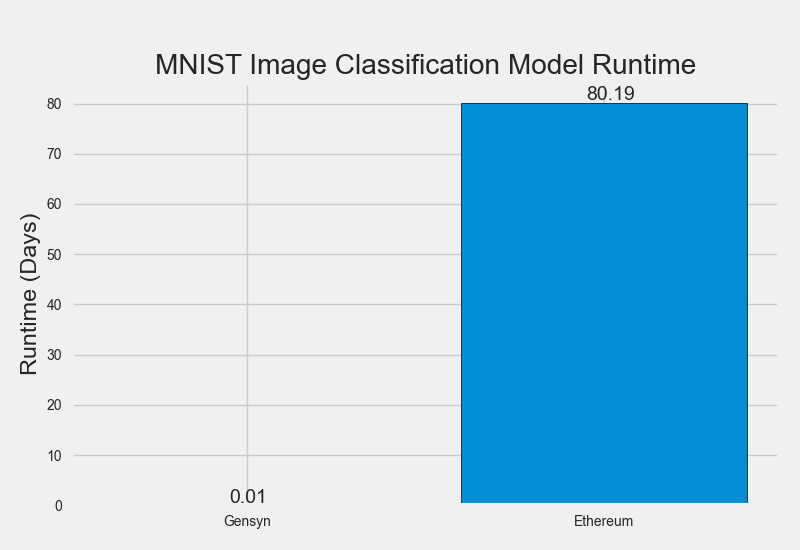
We evaluate our solution through Python simulations in order to assess the magnitude of performance gains delivered by the Gensyn protocol. In this instance, we gauge performance as the aggregate time in seconds taken to complete a 100 epoch training job on a small MNIST image classification model. We test this on a 6-Core Intel Core i7 processor. 
We compare the protocol with 3 alternative approaches: running the model locally (as opposed to using any protocol), running the model using Truebit-inspired replication (with 7 verifiers), and running the model on Ethereum.
Despite the code lacking production-level optimisations, the results show that the Gensyn protocol adds a \~46% time overhead to model training representing a 1,350% performance gain versus Truebit-style replication and 2,522,477% gain versus Ethereum.
## Decentralisation and governance
### Governance
Gensyn Limited is the initial entity that is developing the protocol, hiring the team, and managing the IP (prior to open source launch). Gensyn Limited is a fully remote company, hiring talent from all over the world. Following the Token Generation Event (TGE), Gensyn Limited will handle technical development and the Gensyn Foundation will represent the interests of the protocol.
Tokens will be issued at the TGE by the Gensyn Foundation, which will be governed in a decentralised manner by an elected council and make decisions based on on-chain proposals and referenda. Initially, members of the council will be tightly mapped to core members of Gensyn Limited and the early community in order to quickly develop the protocol. As time goes on, the council will become more decentralised.
The Gensyn Foundation will also control a treasury that will be directed by proposals to further the aims of the protocol by funding the continued development of the protocol itself and the overall ecosystem. The treasury will primarily be funded by taking a very small percentage of each task fee.
## Future development
### Research
We will continue our research into three main areas to improve the protocol: probabilistic verification of ML training using metadata from the optimisation process, pinpoint verification of deterministic ML work for on-chain proof, and parallelisation of ML models over heterogeneous hardware with latency constraints.
This research will strengthen the work verification guarantees and expand the utility of the protocol to include more model primitives and a wider variety of model types.
### Development
Development of the Gensyn protocol will follow three high-level phases: testnet, canarynet, mainnet.
#### Testnet
Initial development will focus on building a testnet implementation of the core technology. Tokens used by the testnet will be non-permanent, and users of the testnet will be early adopters and core members of the community who will be rewarded at the TGE.
#### Canarynet
Following successful testnet iteration, the protocol will launch as a canary network parachain on the [Kusama relay chain](https://kusama.network/). This phase will involve launching the canary utility token that will have real economic value. The canary network can be seen as a beta version of the protocol with access to the newest features and some risk associated with its use. Long-term, canary networks typically offer slightly lower prices and access to bleeding-edge R\&D functionality in exchange for this slight risk.
#### Mainnet
Following a successful parachain launch on the Kusama relay chain, the next phase will be to launch the final live parachain on the [Polkadot relay chain](https://polkadot.network/). This phase will include the launch of the mainnet utility token that will be the main utility token for the protocol. The mainnet will be the hardened, live protocol for full use by any organisation or individual. Features or changes will go through testnet and canarynet iteration before launching on the mainnet.
### Ecosystem
The Gensyn Protocol will be a foundational layer for ML compute, similar to Ethereum for smart contract execution. Going forward, we expect others to build on top of the protocol to provide rich user experiences and specific functionality in numerous niches. We expect this burgeoning ecosystem to start with expert-knowledge-based applications, allowing non-experts to build and deploy ML solutions using abstractions similar to existing Web2 solutions such as [Amazon’s SageMaker](https://aws.amazon.com/sagemaker/) and [DataRobot](https://www.datarobot.com/).
Besides human knowledge in model design, there are three fundamental problems slowing the progress of applied ML:
1. Access to compute power;
2. Access to data; and
3. Access to knowledge (ground-truth labelling).
Gensyn solves the first problem by providing on-demand access to globally scalable compute at its fair market price. The Gensyn Foundation will seek to encourage solutions to two and three through research, funding, and collaborations with other protocols.
### Long-term vision
The Gensyn Protocol will enable anyone to train ML models for any task using a self-organising network that encompasses every source of compute power in existence.
As Web3 Dapps increase in complexity and infrastructure requirements, they are forced to fall back onto Web2 where Web3 resources don't exist. By decentralising ML compute, the Gensyn Protocol brings a crucial infrastructure component natively to Web3 - reducing reliance on Web2 and further strengthening and decentralising the entire ecosystem.
Deep learning has shown incredible generalisation power and looks set to play a huge part in the future of ML. [Foundation models](https://arxiv.org/abs/2108.07258), trained on the Gensyn Protocol, will be decentralised and globally owned - allowing humanity to equally benefit from collaborative ML development and training. Building on these foundation models using fine-tuning will be as simple as defining a task and paying a fair market price for the fine-tuning work - removing the barriers that currently exist.
For decades, ML has progressed in silos, both academic and industrial. The Gensyn Protocol connects these silos through a common infrastructure with decentralised ownership, allowing all of humanity to quickly and collectively explore the future of artificial intelligence as equal pioneers. Combining this network with hierarchically-trained and collectively-owned foundation models provides a path towards a true realisation of AGI - the next step for humanity.
## Get involved
You can follow our progress on [Twitter](https://twitter.com/gensynai). If you're interested in contributing compute resources, using the network for ML tasks, or joining us then please send us a message. We'd love to chat.프로젝트로 돌아가기
