bitpro가 원문에서 글자만 모은 내용이에요. 표·그림·수식은 빠지거나 깨질 수 있어요. 전체 75쪽 중 74쪽
arpatkey/client-configs/blob/main/clients/ens-dao/mainnet/payloads/ensPermissionsUpdate8.json)
* **Zodiac Diff Page:** [link here](https://roles.gnosisguild.org/eth:0x703806E61847984346d2D7DDd853049627e50A40/roles/MANAGER/diff/44zkxJCEz3H0WcK87fvtfsKSrqb3KtOdlx2NJlAWiw?annotations=false)
### Next Steps
The proposal will be introduced in the next meta-governance call. Pending review from Blockful and no revisions following the discussion in during the meta-gov call, this proposal will progress to an on-chain executable vote.
## \[EP 6.39] \[Executable] Treasury Flow Automation
::authors
| **Status** | Passed |
| --------------------- | ------------------------------------------------------------------------------------------------------------------------------------------------------------------------------------------------------------------------------------------------------------------------------- |
| **Discussion Thread** | [Forum](https://discuss.ens.domains/t/21923/) |
| **Votes** | [Snapshot](https://vote.ensdao.org/#/onchain/103727552069485114370289118760519929157657207659236887832122369454255184795333), [Anticapture](https://app.anticapture.com/ens/governance/proposal/103727552069485114370289118760519929157657207659236887832122369454255184795333) |
### Abstract
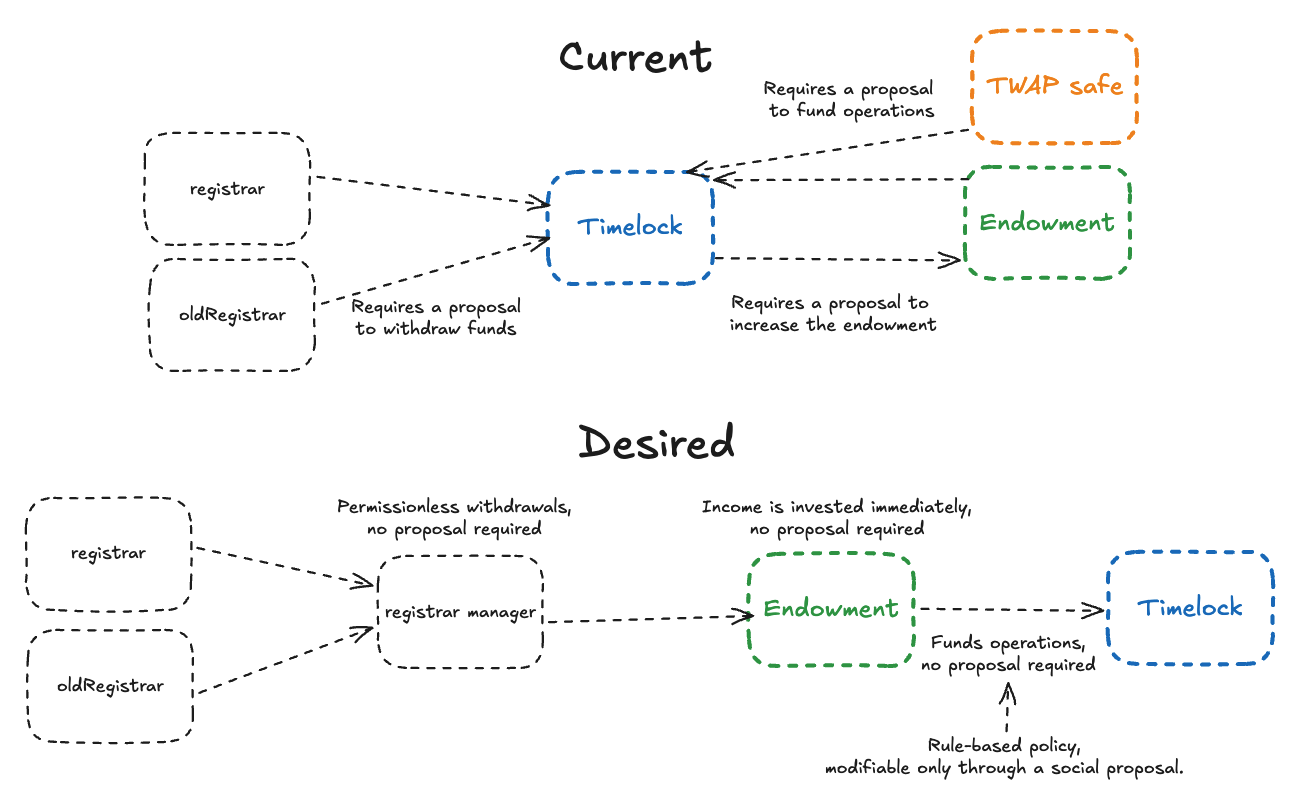
ENS protocol revenue currently requires three separate steps to move from registrar controllers to productive use in the endowment and fund operations. This proposal introduces a Registrar Manager contract that takes ownership of all registrar controllers and enables permissionless withdrawals directly to the endowment. It also configures a Zodiac module permission on the endowment to allow the treasury manager to send ETH and USDC to the timelock without a proposal, following a two-year stablecoin runway policy consistent with the current Investment Policy Statement.
The result is zero proposals for routine treasury operations, faster yield on collected revenue, permissionless withdrawals, and increased income for the DAO. A conservative estimate suggests that since January 2024, approximately $1 million in yield was missed due to idle capital in registrar controllers and the timelock.
### Specification
#### Problem
ENS protocol revenue requires three steps to move from collection to productive use.
Registrar controllers collect ETH from .eth registrations and renewals, and the current controller (controller.ens.eth) already sends withdrawn ETH to the timelock. However, the old registrar controller at 0x283Af0B28c62C092C9727F1Ee09c02CA627eb7F5 holds roughly 772 ETH that requires a dedicated proposal just to withdraw.
Once ETH reaches the timelock, sending it to the endowment (endowment.ensdao.eth) for investment requires another proposal. Capital can sit idle in the timelock for several months before it starts earning yield.
When the DAO needs to fund operational expenses like ENS Labs, the Service Provider Program, or Working Groups, yet another proposal is needed to transfer from the endowment back to the timelock or to execute operations with [twap.ensdao.eth](https://etherscan.io/address/0x02D61347e5c6EA5604f3f814C5b5498421cEBdEB). For context, [EP 6.32](https://discuss.ens.domains/t/ep-6-32-executable-transfer-2-5m-usdc-from-endowment-to-wallet-ensdao-eth/21882) proposed a $2.5M USDC transfer from the endowment to the timelock just to cover Working Group budgets that had already been approved.
On top of that, there is currently roughly 4,148 ETH sitting in the timelock that could be earning yield in the endowment. The operational funding process today is reactive and not smooth. Each transfer requires a full governance cycle, and capital that could be generating yield sits idle throughout.
##### Key Addresses
• Timelock: 0xFe89cc7aBB2C4183683ab71653C4cdc9B02D44b7 (wallet.ensdao.eth)
• Current Registrar Controller: 0x253553366Da8546fC250F225fE3d25d0C782303b (controller.ens.eth)
• Old Registrar Controller (\~772 ETH): 0x283Af0B28c62C092C9727F1Ee09c02CA627eb7F5
• Endowment: 0x4F2083f5fBede34C2714aFfb3105539775f7FE64 (endowment.ensdao.eth)
• Governor: 0x323A76393544d5ecca80cd6ef2A560C6a395b7E3 (governor.ensdao.eth)
• TWAP safe: 0x02D61347e5c6EA5604f3f814C5b5498421cEBdEB (twap.ensdao.eth)
#### Solution
This proposal introduces two components that eliminate all three bottlenecks: a Registrar Manager and an Endowment Zodiac Module permission.
##### Registrar Manager
The Registrar Manager is a contract that becomes the owner of all registrar controllers. Its key properties:
a) Exposes a permissionless withdraw() function that anyone can call. When called, it pulls ETH from each controller and routes it directly to the endowment.
b) The destination address is configurable by the DAO through the timelock, so governance can redirect the flow at any time.
c) Acts as a pass-through for governance calls, meaning the DAO retains full control over controller parameters.
d) New controllers can be added over time.
e) Never holds funds.
[Source code of Registrar Manager contract.](https://github.com/blockful/dao-proposals/blob/ep-registrar-manager-endowment/src/ens/proposals/ep-registrar-manager-endowment/contracts/RegistrarManager.sol)
##### Endowment Zodiac Module
The Zodiac module is already part of how the endowment is managed. This proposal adds a scoped permission that allows the treasury manager (Karpatkey) to send ETH and USDC to wallet.ensdao.eth without a proposal. It cannot send to any other address or use any other token. All other endowment operations remain unchanged.
#### Funding Policy
This is the current suggestion for the funding policy.
The timelock maintains a 6 months runway in USDC (\~$8M at current spending). Each quarter, Karpatkey calculates the current runway on the timelock. If it falls below 6 months, the endowment sends the shortfall. If it exceeds 6 months, no transfer is needed and the excess stays invested in the endowment. If an additional governance proposal requiring capital is approved, this may trigger an earlier runway evaluation and transfer, consistent with this policy.
The initial policy is included in this executable proposal, so no separate vote is needed to get started.
Any future changes to the funding policy require a social vote. This establishes clear expectations about responsibilities and decision-making: the treasury manager handles routine rebalancing within the policy, and the community sets the policy itself.
This proposal remains aligned with the IPS. The required three-year stablecoin runway is calculated at the Endowment level, including stablecoins held and deployed there, as is currently done. The expansion guidelines reference transferring 33% of protocol revenue to the Endowment. This proposal modifies that mechanism by routing revenue directly to the Endowment to improve operational efficiency and capital deployment.
#### Impact
The operational funding process is reactive, requiring a full governance cycle for each transfer. Meanwhile, capital that could be earning yield sits idle in controllers and the timelock for several months at a time.
With this proposal, capital flows from registrars to the endowment as soon as anyone calls withdraw(). The endowment begins generating yield immediately rather than after several months of governance overhead. Operational funding follows a clear quarterly process based on the two-year runway target, removing the need for ad-hoc proposals.
To put this in perspective: looking at the period from January 2024 until now, and considering ETH staking yields if this capital had been allocated to the endowment, a conservative estimate of $1 million in yield was left on the table. This is based on the balances held in the [timelock](https://etherscan.io/address/0xFe89cc7aBB2C4183683ab71653C4cdc9B02D44b7#analytics), the [current registrar controller](https://etherscan.io/address/0x253553366Da8546fC250F225fE3d25d0C782303b#analytics), and the [old registrar controller](https://etherscan.io/address/0x283Af0B28c62C092C9727F1Ee09c02CA627eb7F5#analytics) (which still have a relevant number of registrations). Going forward, every ETH collected will begin earning yield within days, compounding the DAO's income over time.
## \[EP 6.4] \[Social] Service Provider Season 2 Vote Amendment Proposal
::authors
| **Status** | Superseded by [EP 6.5](/dao/proposals/6.5) |
| --------------------- | ------------------------------------------------------------------------------------------------------------------------- |
| **Discussion Thread** | [Forum](https://discuss.ens.domains/t/20526/57) |
| **Votes** | [Snapshot](https://snapshot.box/#/s\:ens.eth/proposal/0xf0c3a2fe4bd085ea74a072cafb830aaadb4830b557a3d122eab36058a17c1860) |
### Abstract
EP 6.3 was passed with a budget of $4.5M for 2025 on the 25th of February and pertains to Service Provider budgets and allocation mechanisms for 2025. After broad discussion between delegates, working groups and service providers, a proposed change to the voting process is now being presented for vote.
### Vote
This is a proposed amendment to the evaluation criteria for Service Providers. On April 1st there was an Delegate All Hands meeting in which many delegates expressed the desire to be able to fine tune their vote in order to express preference over not only the teams, but also their respective budgets. This was followed by extensive discussion between delegates, working groups and Service Providers, leading to the below amendment:
*The goal here is to propose a new rule change while keeping the same properties as having a single budget be decided in one simultaneous vote.*
#### Current Evaluation Process, as voted on snapshot
> **Evaluation Process**
>
> Projects are assessed in ranked order:
>
> * If "None Below" is reached, evaluation stops.
> * If the candidate has been part of the Service provider program for at least a year AND if the extended budget fits within the remaining two-year stream budget, assign to the two-year stream . Subtract the extended budget from the two-year stream budget.
> * Assign to the one-year stream if:
> * The extended budget fits the one-year budget. Subtract its extended budget from the one-year stream.
> * OR if the basic budget fits the one-year budget, subtract the its basic budget from the one-year stream.
> * If none of these conditions are met, the project is eliminated.
#### New proposed rule amendment
The vote will present both extended and basic budgets as separate options and a given voter can pick *either* budget to rank their candidates. They do not need to rank both budget options separately, as they are considered the same candidate.
The rank of each candidate will be the rank of it's highest ranked budget option, according to a Copeland methodology (using average support as a tiebreaker). Then a pairwise comparison will be made between the two budget options and the preferred one will be set as its selected budget.
#### Vote Processing Algorithm
1. **Votes Preprocessing**:
* For providers with both basic and extended budget options, the algorithm enforces the lowest option to be ranked immediately after the highest option (of the same provider).
* If a provider has only one budget option, no special enforcement is needed for that provider.
* This grouping ensures accurate pairwise comparisons between different between different providers and then budget options from the same provider.
2. **Pairwise Comparisons (copeland)**:
* For each pair of candidates (provider), we calculate the total voting power supporting each over the other.
* A candidate wins a head-to-head matchup if the total voting power ranking them higher exceeds that of their opponent.
* Each win contributes 1 point to a candidate's Copeland score.
* The pairwise comparison between basic and extended must also be stored, for defining the preference on the budget.
3. **"None Below" Handling**:
* The "None Below" option serves as a cutoff point in a voter's ranking.
* Candidates ranked above "None Below" are considered ranked.
* Candidates ranked below "None Below" are considered unranked by that voter.
* A ranked candidate always wins against an unranked candidate in pairwise comparisons.
4. **Scoring and Ranking**:
* Candidates are ranked by their Copeland score (descending), with average support as a tiebreaker.
#### Allocation Process
1. **Budget Type Determination**:
* Each provider's budget (basic or extended) is determined by their internal head-to-head match result.
2. **Stream Allocation**:
* Candidates are processed in Copeland ranking order.
* Candidates that are in top 5 and were selected in SPP1, are elegible for the 2-year stream.
* All other candidates receive allocations from the 1-year stream.
* From top to bottom, try to fit projects in the 2 year stream budget, and then on the 1-year stream budget using the standard knapsack algorithm, stopping once budgets are exhausted or None Below is reached.
* If a service providers extended scope got a majority vote over basic scope and the extended scope doesn't fit into the remaining 1-year budget but the basic budget does, then the given service provider's basic budget is included.
* If a candidate is ranked below "None Below", they're rejected regardless of budget availability.
3. **Budget Transfer Mechanism**:
* After processing the top 5 candidates, any remaining 2-year budget transfers to the 1-year stream. Final 1-year budget = (Initial 1-year budget) + (Leftover 2-year budget).
4. **Rejection Criteria**:
* A candidate is rejected if:
* They're ranked below the "None Below" option
* There's insufficient budget
### Updated Timelines
The initial proposal stated a submission deadline of March 31st, and vote to begin *soon* after that.
This vote will be conducted over the next 5 days. Then, if the vote is successful MetaGov will be interfacing with voting UI teams to ensure sufficient testing and timelines before the final SPP vote. There will be a minimum of 3 days between this proposal closing and the start of the final vote, to allow Service Providers to update their proposals if necessary.
### Conclusion
If this amendment proposal passes, the MetaGov working group, delegates and governance UI providers will enact the updated proposal process.
We would like to thank everyone who has taken the time to be involved in this discussion and have been blown away by the level of engagement & productivity throughout.
## \[EP 6.40] \[Executable] Update DNSSEC Algorithm 7
::authors
| **Status** | Passed |
| ---------- | ----------------------------------------------------------------------------------------------------------------------------------------------------------------------------------------------------------------------------------------------------------------------------- |
| **Votes** | [Snapshot](https://vote.ensdao.org/#/onchain/93339540979084434403669350155813124666788975924280943502320960019054315770244), [Anticapture](https://app.anticapture.com/ens/governance/proposal/93339540979084434403669350155813124666788975924280943502320960019054315770244) |
### Abstract
This proposal updates DNSSECImpl's algorithm 7 (RSASHA1-NSEC3-SHA1) to point to the same patched RSASHA1Algorithm contract that already serves algorithm 5. This was inadvertently omitted from the [previous proposal](https://discuss.ens.domains/t/executable-replace-dnssec-oracle-algorithms/21910) which patched algorithms 5, 8, and 13.
### Motivation
The ENS deploy script ([`10_deploy_oracle.ts`](https://github.com/ensdomains/ens-contracts/blob/91c966febd7b55494269df830fc6775f040b927b/deploy/dnssec-oracle/10_deploy_oracle.ts#L64-L68)) maps both algorithm 5 and algorithm 7 to the same `RSASHA1Algorithm` contract, as they share identical RSA+SHA1 verification logic. When the [previous proposal](https://discuss.ens.domains/t/executable-replace-dnssec-oracle-algorithms/21910) was executed, `setAlgorithm` was called for algorithms 5, 8, and 13, but algorithm 7 was missed.
Algorithm 7 currently still points to the pre-patch contract at [`0x6ca8624Bc207F043D140125486De0f7E624e37A1`](https://etherscan.io/address/0x6ca8624Bc207F043D140125486De0f7E624e37A1), which lacks PKCS#1 v1.5 padding validation.
**Current impact is negligible** — no TLD in the ENS ecosystem currently uses algorithm 7. The TLDs affected by the original vulnerability (`.cc`, `.name`) used algorithm 8, which was patched in the previous proposal. However, this should be corrected to match the intended configuration and to close the gap left by the previous deployment.
### Specification
A single `setAlgorithm` call on DNSSECImpl ([`0x0fc3152971714E5ed7723FAFa650F86A4BaF30C5`](https://etherscan.io/address/0x0fc3152971714E5ed7723FAFa650F86A4BaF30C5)):
| Algorithm ID | Contract | Address |
| ---------------------- | -------------------------- | ----------------------------------------------------------------------------------------------------------------------- |
| 7 (RSASHA1-NSEC3-SHA1) | RSASHA1Algorithm (patched) | [`0x58E0383E21f25DaB957F6664240445A514E9f5e8`](https://etherscan.io/address/0x58E0383E21f25DaB957F6664240445A514E9f5e8) |
No new contract deployment is needed — this reuses the same patched contract already serving algorithm 5.
### Transaction
| # | Contract | Function | Parameters |
| - | ---------- | ----------------------------- | ------------------------------------------------- |
| 1 | DNSSECImpl | `setAlgorithm(uint8,address)` | `7`, `0x58E0383E21f25DaB957F6664240445A514E9f5e8` |
Calldata:
```
cast calldata "setAlgorithm(uint8,address)" 7 0x58E0383E21f25DaB957F6664240445A514E9f5e8
```
### Verification
After execution, confirm:
```
cast call 0x0fc3152971714E5ed7723FAFa650F86A4BaF30C5 "algorithms(uint8)(address)" 7
# Expected: 0x58E0383E21f25DaB957F6664240445A514E9f5e8
```
## \[EP 6.41] \[Executable] Endowment permissions to KPK - Update #9
::authors
| **Status** | Passed |
| --------------------- | ----------------------------------------------------------------------------------------------------------------------------------------------------------------------------------------------------------------------------------------------------------------------------- |
| **Discussion Thread** | [Forum](https://discuss.ens.domains/t/22083/) |
| **Votes** | [Snapshot](https://vote.ensdao.org/#/onchain/39893466662181856279242827854933926689925858494049650894234231038376231891860), [Anticapture](https://app.anticapture.com/ens/governance/proposal/39893466662181856279242827854933926689925858494049650894234231038376231891860) |
### Abstract
This proposal introduces a routine update to the permissions for the Endowment Manager. This update expands access to liquid staking and restaking protocols on Ethereum, adds exposure to Morpho USDT vaults, and extends CoW Swap routing to include weETH and eETH.
### Motivation
The update opens positions in Stader and Ether.fi, two liquid staking and restaking protocols that allow the endowment to earn yield on ETH while preserving the ability to exit via standard or express unstaking paths. Adding Morpho's KPK USDT Prime vaults (v1 and v2) provides additional yield opportunities on stablecoin holdings consistent with the Investment Policy Statement (IPS). Extending CoW Swap permissions to cover weETH and eETH supports efficient token management across the expanded position set. These changes are additive and consistent with prior endowment strategy.
### Specification
This proposal adds the following contracts:
#### Additions
##### 1. Liquid Staking & Restaking
| Protocol / Contract | Description | Contract Address (Mainnet) |
| ----------------------------------- | ---------------------------------------------------------- | ------------------------------------------ |
| Stader 프로젝트로 돌아가기
