bitpro가 원문에서 글자만 모은 내용이에요. 표·그림·수식은 빠지거나 깨질 수 있어요. 전체 75쪽 중 71쪽
esearch will be conducted to help provide context for how other decentralized communities, in web3 or beyond, have dealt with similar challenges. This includes a full research report and community‑facing materials, designed to support transparent deliberation, consensus‑building, and staged implementation of governance and organizational reforms aligned with ENS DAO’s long‑term mission.
#### Phase 1 - Stakeholder Analysis and Pre-Retro Data Gathering
**Overview**
Phase 1 establishes the analytic and relational foundation for the entire study by clarifying ENS DAO’s purpose, mapping its stakeholder ecosystem, and documenting how different groups currently experience governance, coordination, and execution. Through background research, structured interviews, community discussions, and targeted external scanning, this phase generates a shared, multi‑perspective picture of “how ENS DAO is working today” and what outcomes its stakeholders believe recent spending and governance decisions were meant to achieve.
#### Phase 1A. Stakeholder Analysis
**Goal**
To have a clear understanding of
* What is the purpose of the DAO?
* What are the problems the DAO is facing?
* What were the desired outcomes of your spend that we will be reviewing in Phase 2?
**Activities**
1. Background context and ENS DAO research
2. Thoroughly reviewing the forum, community calls, and any other relevant materials, including initial conversations with the MetaGov team
3. Map the relevant stakeholders of ENS DAO (i.e., Delegates, Tokenholders, Stewards, Service Providers, Labs, etc.)
4. Role and formal authority (voting rights, execution rights, advisory)
5. Interests and known incentives
6. Reported engagement patterns and participation constraints
7. Known areas of alignment and conflict
8. Starting to sketch some potential areas for improvement
9. Conduct stakeholder interviews
10. Conducting 30+ hours of interviews with key stakeholders (MetaGov team, other working groups at the DAO, select delegates, Labs team, service providers, any other stakeholders? We ideally get community support for generating the list.)
11. Creating a process for anonymous and/or asynchronous contribution to the stakeholder analysis portion for those who are not able or interested in being interviewed
12. Potentially hosting up to 5 hours worth of community discussions, whether existing calls or dedicated town halls, to better understand the nature of the challenges from the perspective of both delegates and the broader community
13. Producing an overview of the perceived challenges from the perspective of key stakeholders, relating to how ENS DAO can improve
14. Present findings and recommendations to the MetaGov team and the community
15. Producing at least one forum post outlining the results of the research and findings
16. Partaking in 1-2 community calls to discuss conclusions and receive feedback
17. Hosting at least 1-2 dedicated calls with the MetaGov team to receive feedback on the recommendations
18. Producing a revised list of recommendations that factor in both the research findings and the community’s and MetaGov’s reception of said findings
**Outputs:**
1. Summary of the current state of affairs in terms of ENS DAO (Activity 1 above) and a list of whom to interview
2. Outlining the research questions that are at the core of the retro (see initial draft of research questions above)
#### Phase 1B. Pre-Retro Data Collection
**Goal:**
* To gather all of the relevant data that needs to be analyzed to understand if the desired outcomes defined through Phase 1 were or were not accomplished as part of conducting the full retro in Phase 2
**Activities:**
* Design and implement a structured data-inventory process (templates and checklists) to identify all initiatives, grants, working‑group programs, and major governance decisions to be included in the retrospective.
* Produce a master catalog of relevant documents and data sources (forum threads, proposals, working‑group reports, treasury and disbursement data, ENS Labs updates, call notes, dashboards, and any off‑chain documentation).
* Create and maintain a shared data repository for unstructured documents (e.g., forum exports, meeting notes, slide decks, research reports) with clear naming conventions and access controls.
* Outline and document standard operating procedures for sharing relevant data with the research team, including who is responsible for providing which data, in what format, and on what timeline.
* Where needed, work with stewards, service providers, and ENS Labs to generate structured exports of key quantitative data (e.g., transaction histories, budget vs. actuals, participation metrics) for inclusion in the repository.
* Log initial data quality issues and gaps (e.g., missing reports, inconsistent categorization, incomplete forum documentation) to inform both the design of the retrospective in Phase 3 and any recommendations about future data practice
**Outputs:**
* A data repository that will be used for the actual retrospective analysis
#### Milestone 1
Upon completion of Phase 1, the research team will produce a Phase 1 Stakeholder Analysis and Pre‑Retro Data Collection package, including: (a) a concise summary of ENS DAO’s purpose, problem statements, and desired outcomes as articulated by key stakeholder groups; (b) a stakeholder map with roles, authorities, incentives, and observed engagement patterns; and (c) a documented inventory and structure for the pre‑retro data repository. This package will be submitted to the designated ENS stakeholder group (e.g., MetaGov team, stewards, and selected delegates) for review.
Within one week of submission, the research team and ENS stakeholders will hold a milestone check‑in call to: (1) validate or refine the emerging picture of ENS DAO’s purpose, challenges, and intended outcomes; (2) confirm that the planned research methods and data sources for subsequent phases are appropriate and aligned with ENS priorities; and (3) surface any gaps, concerns, or additional questions. Following this session, the research team will revise the Phase 1 outputs and, where needed, adjust research questions, methods, or sampling plans to incorporate ENS feedback before formally closing the Phase 1 milestone.
#### Phase 2 - Retrospective Assessment
**Goal**
Analyse the data capture in Phase 1B in light of the purpose and desired outcomes articulated in Phase 1 & the Milestone 1 review to assess whether the spend achieved what was intended.
**Activities**
Phase 2 will systematically analyze the initiatives, grants, and governance processes identified in Phase 1 using the data assembled in the pre‑retro repository. Activities will include:
* Reconstructing the intended theory of change and desired outcomes for major spending streams
* coding qualitative and quantitative evidence against those intended outcomes
* identifying cross‑cutting patterns of success, failure, and unintended consequences.
The team will convene at least one milestone review (see below) with ENS Stakeholders and relevant stewards to validate interpretations, refine emerging findings, and prioritize issues that require deeper investigation before final synthesis.
**Outputs**
The research team will conduct a structured retrospective assessment that links ENS DAO’s historical spending and governance decisions to observed outcomes. Outputs will include:
* A set of initiative‑level and thematic retro summaries
* An integrated analysis of root causes behind recurrent challenges
* A prioritized list of leverage points where institutional or procedural changes are most likely to improve coordination and execution.
These outputs will feed directly into Phase 4, providing the empirical backbone for the final recommendations and governance roadmap.
#### Milestone 2
Upon completion of Phases 2, the research team will complete a retrospective of the spend of ENS DAO. This will include qualitative and quantitative data needed to produce the reports in Phase 3.
Within one week of submission, the research team and ENS stakeholders will convene a milestone check‑in call to: (1) Share what the report structure will look like to provide initial feedback; and (2) Review some initial learnings from the retro before moving onto Phase 3.
#### Phase 3: Synthesis, Recommendations, and Community Validation
**Goal**
Integrate findings from Phases 1 & 2 into a coherent diagnosis of ENS DAO’s governance and operational challenges and develop a prioritized, evidence‑based set of recommendations and a governance roadmap that are validated with ENS stakeholders.
**Activites**
1. Synthesis of findings across phases
* Map stakeholder‑identified challenges and desired outcomes from Phase 1 against the retrospective findings from Phase 2.
* Identify areas where multiple lines of evidence converge on the same problems and candidate solutions, as well as areas of persistent uncertainty, disagreement, or trade‑offs that require explicit governance choices.
1. Recommendation development and structuring
* Draft recommendations, each with a concise problem statement, proposed change, evidence base, risks, and implementation considerations.
* Organize recommendations into clear categories, such as:
* Governance infrastructure and process reforms (e.g., delegation mechanisms, proposal workflow, voting procedures, quorum/thresholds)
* Organizational structure and accountability (e.g., working‑group mandates, steward terms and elections, standing committees)
* Communication and information architecture (e.g., forum practices, information flows, transparency standards)
* Cultural and incentive alignment (e.g., contributor recognition, incentive design, participation norms)
1. Roadmap and success criteria
* Sequence recommendations into a pragmatic roadmap with near‑term, medium‑term, and longer‑term actions, including dependencies and prerequisites.
* Propose high‑level success criteria and monitoring indicators for key reforms, so ENS DAO can assess whether implemented changes are delivering the intended improvements.
1. Stakeholder review and validation
* Share a draft synthesis and recommendations package with ENS stakeholders (e.g., MetaGov team, stewards, key delegates) for review.
* Facilitate at least one discussion session to assess the clarity, feasibility, and perceived legitimacy of the recommendations, and to incorporate stakeholder feedback prior to finalization.
**Output**
1. Full research report with findings and recommendations
2. Community‑facing materials
* One or more forum posts summarizing major findings and recommended next steps for ENS DAO.
* A slide deck for use in community calls and steward discussions.
* A one‑page summary highlighting top recommendations, rationale, and immediate next actions for decision‑makers and contributors.
### Timeline and Budget
We propose a workplan that concludes the week of April 6th, however, the learnings could be shared in more informal outputs and via community calls starting mid-March. This is based on my understanding of realistic governances timelines.
**Reminder of phases:**
Phase 0: Proposal on the forum through voting
Phase 1: Stakeholder analysis and data collection
Phase 2: Retrospective analysis
Phase 3: Report synthesis
Here is a visual breakdown of the phases to give a sense of timing:
[Screenshot 2025-12-17 at 7.29.58 PM428×435 8.06 KB](https://discuss.ens.domains/uploads/db9688/original/2X/7/724520f343850f2a2ce473d197909e2c9f874b47.png)
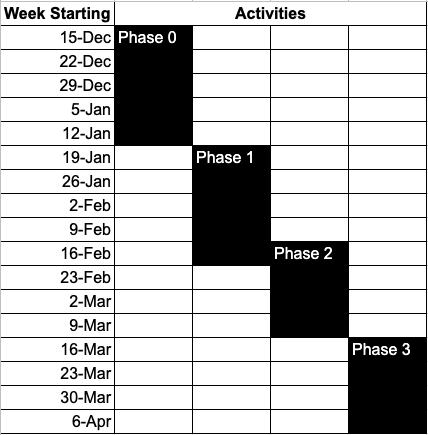
Here is [a sheet](https://docs.google.com/spreadsheets/d/16R4frGKTBLsKu9jbbpOm_PcdbuxuCOATyHx77TthmhQ/edit?usp=sharing) that provides a tentative breakdown of activities.
The budget request for this work is $125,000. This budget will cover the cost of labor and any relevant tooling that can be used to enhance the outcomes.
* The cost of each phase comes out to $37,500 (doing an even split)
* Metagov takes 10% overhead for legal and administrative costs
### Team Composition
Eugene Leventhal and Mike Cooper will lead the team. Additionally, there will be some other contributors from an advisor or two, the OpenGrants team, a data analyst, and potentially an additional research contributor to support delivery of the work in a timely manner.
**Eugene Leventhal**
* Eugene is currently the Head of Governance and Operations at Octant and a Research Director at Metagov, where he leads the [Grant Innovation Lab](https://grant.metagov.org/) and contributes to DAOstar.
* Eugene has been coordinating with various ENS stakeholders since early November to produce this proposal and will be the lead advisor on the project, focusing on co-defining the overall strategy, producing and reviewing all protocols and materials to be used, build the team, and program manage the effort.
**Mike Cooper**
* Mike is a Senior Researcher at Metagov, where he recently published the Grant Impact Handbook.
* Mike has helped shape this proposal and will be the primary research and execution lead on the project.
**Other contributors may include:**
* Christopher Lema and/or Tanisha Katara as advisors
* Sam McCarthy and/or Rashmi Abbigeri from DAOstar’s Open Grants team to help with Phase 1B and 2
* TBC data analyst
* TBC additional research contributor
## \[EP 6.31] \[Temp Check] Delegation Incentives Program
::authors
| **Status** | Passed |
| --------------------- | ------------------------------------------------------------------------------------------------------------------------- |
| **Discussion Thread** | [Forum](https://discuss.ens.domains/t/21824/) |
| **Votes** | [Snapshot](https://snapshot.box/#/s\:ens.eth/proposal/0xf0ad5ad5a1ee353a65424a83e74f2b8846b16885a4be99af26b5162bfa78c644) |
### Abstract
ENS is safer when voting power sits with active delegates, not idle wallets. We propose a 90-day pilot that pays incentives to both active delegates and their delegators. Guardrails: (1) a balance-per-second factor for delegators (capped at 180 days) to reduce sybils, (2) a 1 ENS minimum payout per address to avoid inefficient micro-transfers, and (3) payout caps per-delegate and per-delegator to avoid concentration and strengthen long-term capture cost.
### Specification
#### Context/Continuity
We are moving forward with our [ENS incentives program that we requested feedback last year](https://discuss.ens.domains/t/rfc-delegation-increase-incentives-system/21546). After many discussions and incorporating feedback from the community, we ended up with a few changes:
* Success metrics reporting incorporated to the program
* Holder reward calculations adapted from using ( time holding more than 1 ENS \* current balance) to using time weighted balance, better described below.
* Delegate rewards use time weighted balance over the period of the round instead of average balance on proposal snapshots during the round.
#### Why this matters
* More active voting power raises capture cost and reduces capture risks.
* A strong base of active delegates reduces reliance on emergency mechanisms.
* We incentivise for sustained activity, not outcomes, particular vote choices, or one-time votes.
***
#### Proposal (Pilot v1)
**Scope**: 90 days, three monthly rounds.
**Funding**: One proposal of 90k ENS to be managed by the metagov stewards for distribution. Usage can range from 15k to 90k ENS, any remainder will be sent back to treasury after the program.
**Payout cadence**: Monthly, with public snapshots and distribution files.
**Metric for allocation amount**: Voting power increase MoM on active delegates (more that 7 votes in the last 10 proposals)
| Active VP Increase | ENS Total | Dollar value\* | Delegate Cap | Holder Cap |
| ------------------ | --------- | -------------- | ------------ | ---------- |
| 0-10% | 5000 | $50k | 50 | 250 |
| 10-20% | 8000 | $80k | 80 | 400 |
| 20-30% | 10000 | $150k | 100 | 500 |
| 30-50% | 15000 | $150k | 150 | 750 |
| 50-75% | 20000 | $200k | 200 | 1000 |
| 75-100% | 25000 | $250k | 250 | 1250 |
| Above 100% | 30000 | $300k | 300 | 1500 |
*Dollar values are figurative just to give perspective of cost, at $10/ENS on Jan 16th.*
##### Who earns?
* Active Delegates and their Delegators.
##### Active Delegate threshold
* An active delegate is an address that voted on at least 7 of the last 10 on-chain proposals (rolling).
***
#### Incentives Program Campaign
We propose launching the pilot with a redelegation campaign, with 5 ETH of sponsored gas via delegateBySig, and a visibility campaign to bring long-time holders back into governance.
Reasoning:
**Friction removal**: With sponsored gas + simple redelegation flows, we can remove cost/UX friction to convert passive holders into increased attack costs. Combined with time-held weighting for the incentives, this promotes durable active voting power rather than a one-off spike.
**Details**
* Sponsored gas for redelegations using delegateBySig.
* Featured list of active delegates (meeting thresholds) with transparent stats.
* Progress dashboard: live redelegations, active VP growth, and countdown to Round distributions.
***
#### How rewards are split

Let **R** be the monthly reward pool (in ENS).
#### 1) Delegate pool - **10% of R**
Split among **Active Delegates**, proportional to the average voting power they held that month.
* **AVP(j)** = average voting power held by Active Delegate j during the month
* **Σ\_k AVP(k)** = sum of AVP across all Active Delegates
* **delegate\_reward(j)** = AVP(j) / Σ\_k AVP(k) \* (10% of R)
**Per-delegate cap:** `min(delegate_reward, 1% of R)`.
Excess from caps is redistributed pro-rata within the delegate pool to those still under cap (repeat until no one breaches the cap).
***
#### 2) Delegator pool - **90% of R**
Split among **delegators who are delegated to an Active Delegate at distribution time**, using **time-weighted ENS balance over the last 180 days**.
##### Eligibility
A delegator is eligible if, **at the distribution cutoff**, their address is **delegated to an Active Delegate**.
##### Definitions
* **\*TW(i)** = "180-day time-weighted balance" (average balance across the window):\*
This is measured based on the initial balance and each transaction in the period, the resulting balance of the address after that transaction is used with the total time until it changes again, ensuring a balance per second average over the 180 days window.
##### Reward formula
* **delegator\_reward(i)** = TW(i) / ΣW \_ (0.90 \_ R)
If you are delegated to an **Active Delegate at distribution time**, your reward is based on your **average ENS balance over the last 180 days**. Your share equals your 180-day average balance divided by the total sum of 180-day average balances of all eligible delegators, multiplied by **90% of the monthly ENS rewards pool**.
**Per-delegator cap:** `min(delegator_reward(i), 5% of R)`.
Excess from caps is redistributed pro-rata within the delegator pool to those still under cap (repeat until no one breaches the cap).
***
Rewards are **viewpoint-neutral**, meaning they don’t benefit a specific type of voting behavior. Only **activity** and **time-weighted balance** variables matter.
***
#### Pool size increases and expected APY
To make the program interesting for holders to re-engage governance, we have aimed for high APYs, using the holders that don’t reach the individual reward cap as reference.
Our goal is to make the program more rewarding as delegations increase, so every delegate and delegator is incentivised to support this growth. Without the result based increase, holders would be better off trying to avoid delegation growth to keep more of the pool for themselves.
All APYs mention프로젝트로 돌아가기
